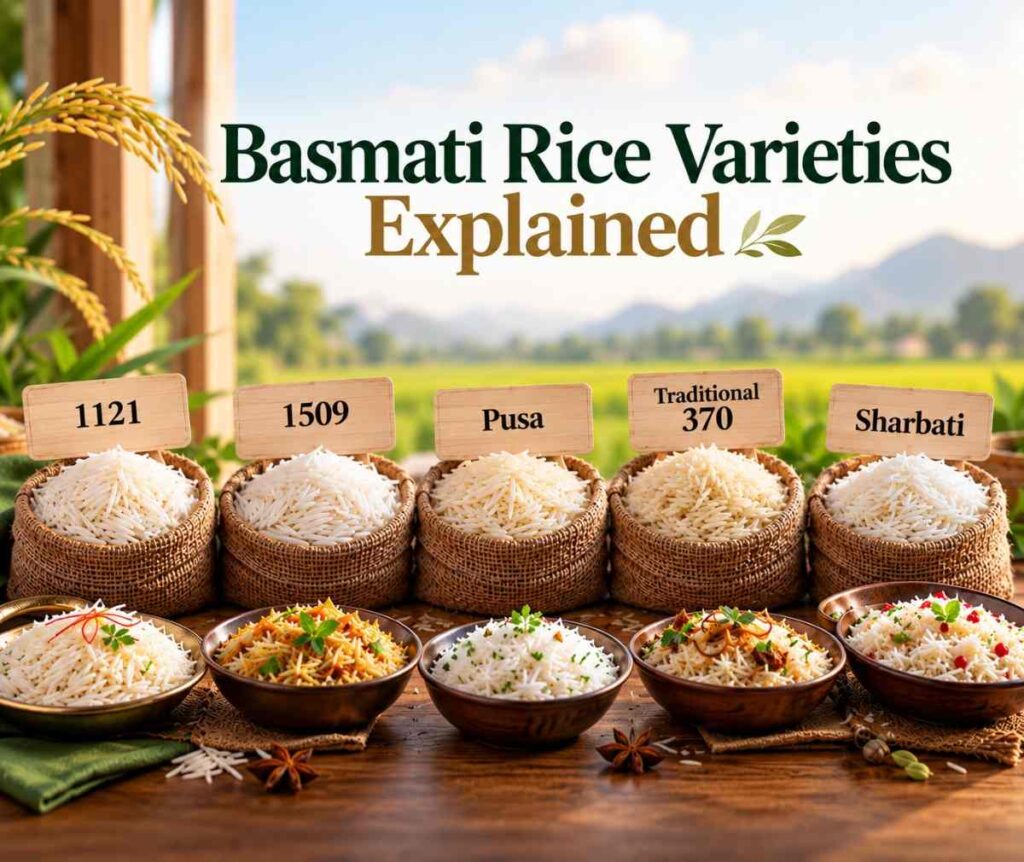
Basmati Rice Varieties Explained: Pusa 1121, Pusa 1509, Pusa 1401, Traditional Basmati 370 & More
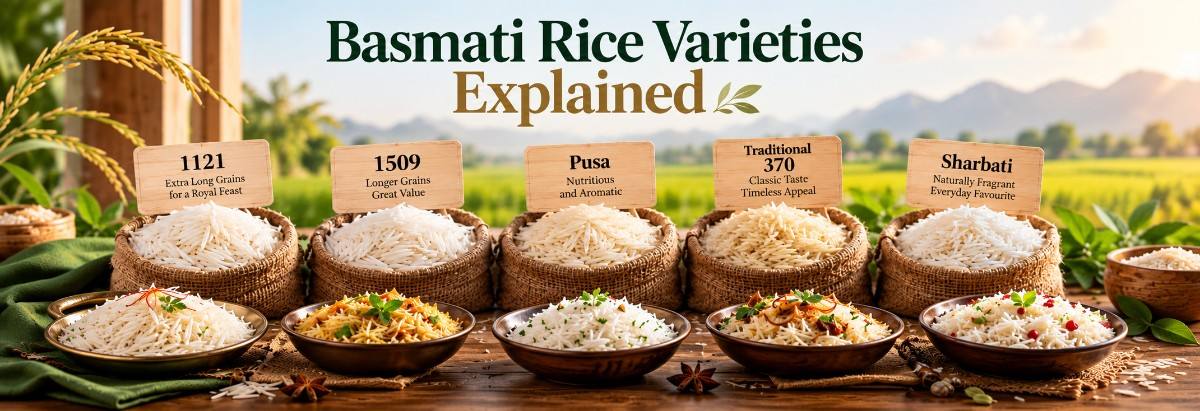
Basmati is not just one type of rice. It is a family of notified varieties, each differing in grain length, aroma, cooked texture and price. Pusa Basmati 1121 is known for its long grain, Traditional Basmati 370 for its strong aroma, and Pusa Basmati 1509 for its shorter crop duration and yield advantages. Sharbati rice, meanwhile, is a long-grain rice that is not a notified basmati variety.
Key Takeaways
- Pusa Basmati 1121 is known for its exceptionally long grain and significant elongation when cooked, making it a popular choice for premium packs such as Leysha Nayaab Biryani and Leysha Punjab-e-Hind.
- Pusa Basmati 1509 is a long-grain, short-duration variety that generally costs less than Pusa 1121, making it a practical choice for everyday meals, biryani and other rice dishes. It is also used in Leysha Supermaxx Chef Collection Basmati Rice.
- Pusa Basmati 1401 is part of a group of improved varieties developed at ICAR-IARI rather than being a single broad category of basmati rice.
- Traditional Basmati 370 has a shorter grain than 1121 but is known for its distinctive aroma and is typically positioned at a higher price point.
- Sharbati rice is a long-grain rice commonly sold alongside basmati, but it does not appear on India’s notified basmati variety list.
What Makes a Rice Legally Basmati?
Two things matter: where it is grown and which variety it belongs to.
Basmati has a Geographical Indication covering Punjab, Haryana, Himachal Pradesh, Delhi, Uttarakhand, western Uttar Pradesh and Jammu and Kashmir. This means that rice grown outside the recognised geographical area does not qualify as basmati under the GI framework.
The variety matters too. Basmati varieties must be notified under the Seeds Act, 1966, and APEDA maintains the official list. APEDA also specifies physical characteristics that basmati must meet, including grain length and other parameters.
One particularly interesting characteristic is cooked length. Basmati is assessed not only by the length of the raw milled grain but also by how much the grain elongates during cooking.
Basmati variety comparison
| Variety | Grain length | Aroma | Cooked behaviour | Best suited for | Relative price |
|---|---|---|---|---|---|
| Pusa Basmati 1121 | Very long | Moderate | Elongates significantly and stays separate | Biryani, pulao, special occasions | High |
| Pusa Basmati 1509 | Long | Moderate | Cooks relatively quickly and separates well | Daily meals, jeera rice | Medium |
| Pusa Basmati 1718 | Long | Moderate | Firm and holds its shape | Everyday and bulk cooking | Medium to high |
| Traditional Basmati 370 | Medium-long | Strongest | Softer and highly aromatic, with less elongation | Festival cooking, plain rice | Highest |
| Sharbati | Long | Mild | Softer, with comparatively more breakage | Budget-friendly daily cooking | Low |
Pusa Basmati 1121
Pusa Basmati 1121 has changed what many shoppers expect a basmati grain to look like. It is among the longest milled grains in widely traded basmati varieties and elongates significantly when cooked, giving you the long, separate grains often associated with restaurant-style rice.
But the variety name is only part of the story. Grading matters too. Mills sort 1121 by grain length after milling and sell the longest grades as XXL or XXXL. So, when you see 1121 XXXL on a pack, the XXXL refers to the grain grade, not a different variety.
There is another detail on the pack that matters: processing. Rice can be sold as steam, Sella or raw basmati, and each processing method can influence the final cooked texture.
Pusa Basmati 1509
Pusa Basmati 1509 is a shorter-duration variety and generally requires less water than some longer-duration varieties. Its shorter growing period can contribute to a lower cost compared with 1121.
The grain is slightly shorter than 1121 and cooks relatively quickly.
For dal chawal, jeera rice or a weekday pulao, 1509 can be a practical choice. For longer, heavily spiced cooking, however, its faster cooking time means you need to be more careful about overcooking.
Pusa basmati as a family
Pusa Basmati 1, 1401, 1509, 1637, 1718 and 1121 are improved varieties developed through breeding programmes at ICAR-IARI in Delhi.
Here, “improved” refers to agricultural traits and breeding objectives, not necessarily better taste or cooking quality. Breeders have focused on traits such as disease resistance, crop duration and yield while maintaining desirable grain characteristics and aroma.
Pusa Basmati 1718 is particularly similar to 1121 in several grain and cooking characteristics. It was developed with improved resistance to bacterial blight. So, when a brand lists 1718 instead of 1121, it does not automatically mean you are getting lower-grade rice.
Traditional Basmati 370
Traditional Basmati 370 is considered a heritage variety and may also be associated with names such as Dehraduni or Taraori.
It has a shorter grain and less elongation than 1121, but is particularly known for its distinctive aroma.
It can also command a higher price because traditional varieties generally have lower yields and can be more challenging to cultivate.
This is one of the most useful things to understand about basmati rice: grain length and quality are not the same measure.
If aroma is your priority, 370 offers a very different experience from 1121. If you want exceptionally long, separate grains, 1121 may be more suited to that preference.
Sharbati
Sharbati rice is a long-grain, mildly aromatic rice that is widely sold in India and is often found next to basmati on store shelves, usually at a lower price.
It does not appear among the varieties notified as basmati under the Seeds Act, 1966.
The confusion often comes from how it is displayed, especially when it sits alongside basmati on the shelf. Sharbati can be a practical choice for everyday cooking when you are specifically looking for a long-grain, non-basmati option.
The important thing is to know what you are buying, particularly when comparing a Sharbati pack with basmati.
Grain uniformity can also be one indicator to examine if you are concerned about a mixed or adulterated rice pack, although visual inspection alone cannot conclusively establish adulteration.
Which basmati variety should you buy?
Instead of asking which variety is the best, think about which one suits your cooking needs and occasion.
- Everyday dal chawal or jeera rice: 1509 or 1718. For everyday meals, you may not need the extra grain length that 1121 offers.
- Biryani or pulao for guests: 1121, particularly an aged variety. Grain length and separation can make a noticeable difference to the final dish.
- Festival cooking or plain rice with a simple curry: Traditional Basmati 370, where aroma is an important part of the experience.
- Budget-friendly daily use: Sharbati, when you specifically want a non-basmati long-grain option.
One thing to keep in mind across all these varieties is that the variety name tells you about the rice, but not necessarily how it has been aged or milled.
A well-aged 1509 can sometimes cook better than a freshly harvested 1121, depending on the rice, ageing, milling and processing.
Where Leysha fits
Leysha Basmati Rice is milled and packed by SSIEL, an India-based rice exporter.
Its range includes 1121 basmati differentiated by grain grade and processing. Nayaab Biryani and Royale use 1121 XXXL Golden Sella, while Regal uses 1121 XXXL Cream Sella. Other products in the range offer additional options for different cooking needs.
Frequently asked questions
Which basmati rice has the longest grain?
Pusa Basmati 1121 is known for its exceptionally long milled grain among commercially traded basmati varieties, and it elongates significantly when cooked. Grain length is one of the physical parameters used to assess basmati, alongside factors such as breadth, length-to-breadth ratio and cooked grain characteristics.
What does 1121 XXXL mean on a rice pack?
XXXL is a grain-length grade, not a variety. After milling, 1121 basmati can be sorted by grain length, with longer grades commonly sold as XXL or XXXL. The rice is still Pusa Basmati 1121; the grade indicates the grain-length category.
Is sharbati rice real basmati?
No. Sharbati rice is a long-grain rice with mild aroma, but it is not among the varieties notified as basmati under the Seeds Act, 1966. It is a legitimate rice sold under its own name, but it should not be confused with notified basmati.
Which basmati is best for daily use?
Pusa Basmati 1509 or 1718 can be suitable for everyday cooking. Both offer long grains and can work well for everyday rice dishes. 1121 or Traditional Basmati 370 can be considered when grain length or aroma is a more important part of the dish.