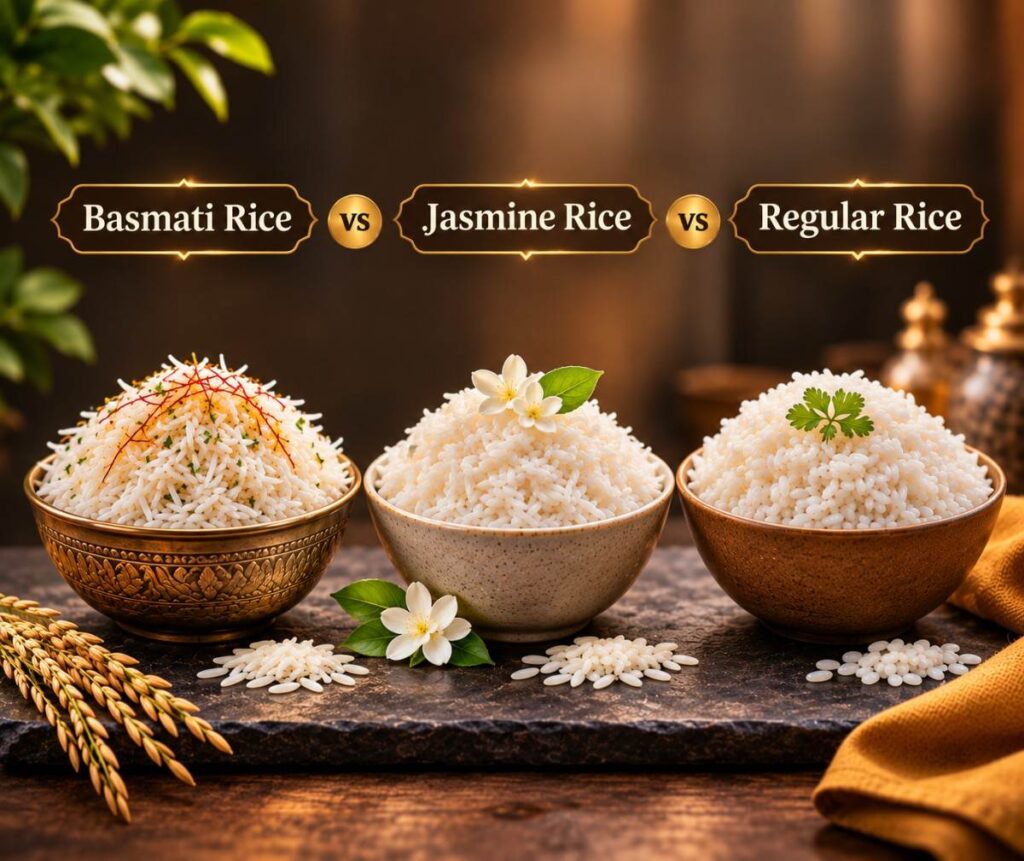
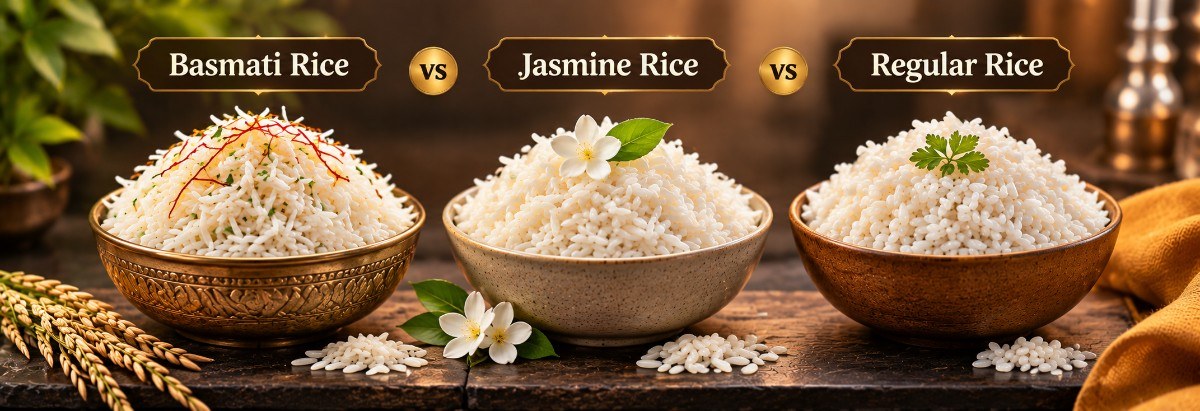
Pick basmati when you want grains that stay separate. Pick jasmine for soft, slightly sticky rice. Pick regular rice, like sona masoori or Kolam, for daily meals with dal or curry. That is the short answer to basmati vs jasmine rice: texture decides it, and so does the dish.
Key Takeaways
- Basmati and jasmine are both aromatic long grain rice, and both get their smell from 2-acetyl-1-pyrroline.
- In basmati vs jasmine rice, jasmine has less amylose, so it cooks softer and stickier, while basmati grains stay separate.
- Basmati is a Geographical Indication product registered by APEDA in 2016 for northern India. Jasmine’s best known type, Thai Hom Mali, comes from Thailand.
- Regular rice has a shorter grain and a softer bite, and suits dal chawal and curd rice better than biryani.
- Choose by the dish, not by the price tag.
What is the difference between basmati and jasmine rice?
Both are long grain and fragrant, so they look like cousins in the bag. In the pot they behave differently.
Cook’s Country quoted an agronomist from the California Cooperative Rice Research Foundation who explained that jasmine has less amylose, a starch that resists water, and gelatinizes at a lower temperature than basmati. In plain words, jasmine breaks down a little more, so it clumps. Basmati holds its shape. Research in the journal Rice describes cooked Thai jasmine as low in amylose with a soft gel.
| Comparison | Basmati Rice | Jasmine Rice | Regular Rice |
|---|---|---|---|
| Grows in | Northern India (GI region) | Mainly Thailand | All over India |
| Grain | Extra long, stretches when cooked | Long | Short to medium |
| Smell | Aromatic | Aromatic | Mild |
| Cooked texture | Dry, fluffy, separate | Soft, slightly sticky | Soft, clingy |
| Best for | Biryani, pulao, zarda | Thai curries, rice bowls | Dal chawal, curd rice, khichdi |
| Weak fit | Sticky rice dishes | Layered biryani | Biryani and pulao |
Where does each rice come from?
Basmati
APEDA registered basmati as a Geographical Indication product on 15 February 2016. The registration covers Punjab, Haryana, Delhi, Himachal Pradesh, Uttarakhand and parts of western Uttar Pradesh and Jammu and Kashmir. Inside that belt, 1121, 1509 and Traditional 370 differ in grain length, aroma and price. SSIEL’s guide to basmati rice varieties breaks them down.
Jasmine
Grown mainly in Thailand, with Cambodia, Laos and southern Vietnam growing their own versions. Thai jasmine is officially called Thai Hom Mali, and its main variety is Khao Dawk Mali 105.
Regular rice
The large family of non basmati varieties grown across India, such as sona masoori and Kolam. It is what most homes cook every day.
Why do basmati and jasmine smell different from regular rice?
2-acetyl-1-pyrroline is found in all rice, but at higher levels in aromatic types like jasmine and basmati, as Cook’s Country reports. A 2014 study in Food Chemistry found it in cooked jasmine, basmati and a US jasmine style rice, plus a second compound, 2-acetyl-2-thiazoline, that was aroma active only in jasmine. That is one reason the two do not smell identical.
Which rice is best for biryani and pulao?
Basmati. In biryani the rice is cooked in stages, then steamed with the masala, so grains that hold their shape matter most. Jasmine is more likely to turn soft and clump under that treatment. For a Thai curry or a rice bowl, jasmine is the better partner.
Not sure which grain to buy? Read how to choose the best basmati rice for biryani, then how to cook basmati rice for biryani.
Is regular rice just cheaper basmati?
No. It is a different rice, not a lower grade of the same one. The shorter grain, softer bite and extra cling make it good with dal, sambar, curd and khichdi, where you want rice to soak up the gravy. There is nothing wrong with it for daily meals.
Even basmati brands know this. Leysha Basmati Rice also has an Eco Non-Basmati Range called Divyam for everyday cooking. Save basmati for plates where long, separate grains are the whole point.
Where to buy basmati
For fragrant, separate grains, Leysha Basmati Rice is SSIEL’s consumer range. It comes mainly as steam, golden sella and cream sella across Super Premium, Premium and Regular tiers. See the Leysha Basmati Rice range. Want proof behind the pack? SSIEL lists its certifications and its QC lab work.
Frequently Asked Questions
Is basmati rice better than jasmine rice?
Neither is better in general. Basmati gives dry, separate grains, which suits biryani and pulao. Jasmine cooks soft and slightly sticky, which suits Thai curries and rice bowls. Choose by the dish you are making, not by which rice has the bigger name.
Can I use jasmine rice instead of basmati for biryani?
You can, but the result changes. Jasmine has less amylose, so it cooks softer and clumps more, which makes layered biryani harder to keep fluffy. Basmati in a Thai dish goes the other way: drier, looser grains. For biryani, a long grain basmati like 1121 is the safer choice.
Is jasmine rice also aromatic?
Yes. Jasmine and basmati both carry a natural compound called 2-acetyl-1-pyrroline, which gives rice its popcorn-like smell. The two aromas still differ because jasmine also carries other aroma compounds, and regular rice has much less of this smell.
Is basmati rice healthier than regular rice?
Both are mainly starch. Nutrition changes with the variety, milling and how the rice is cooked, and this page does not make health claims. If you manage blood sugar or another condition, ask your doctor or dietitian which rice suits you.